ARTIST JOURNAL
Fine art paper explained: matte, textured cotton rag and metallic pearl

Paper is the part of a print collectors touch first and understand least. They'll run a thumb along the edge, tilt it to the light and decide in a second whether it feels like a serious object. That decision has very little to do with gsm and a great deal to do with surface. This guide explains the three fine art papers Print Punch prints on, what each does to your artwork, where the size limits come from, what each costs, and how to choose for your work rather than for a spec sheet.
The three papers at a glance
- 230gsm Premium Matte Fine Art Paper. The standard. Smooth, glare-free, faithful to detail and subtle colour. Available in all six listed sizes, framed and unframed.
- 240gsm Textured Cotton Rag Paper. A high-quality textured cotton-rag paper with a premium archival finish. Available up to 100 × 130 cm, framed and unframed.
- 260gsm Metallic Pearl Paper. A subtle reflective sheen that lifts light and colour. Available in all six listed sizes, framed only.
All three are printed with archival pigment inks. On the framed paper prints product page you choose paper stock alongside size and frame finish. On the unframed fine art prints page you choose between the matte and cotton rag stocks. The frames and materials page records the stock names and weights so you can quote them to collectors.
What gsm does and doesn't tell you
Grams per square metre measures weight, not quality. A 230gsm paper is substantial, roughly twice the weight of ordinary office paper, and it lies flat, resists cockling under heavy ink and feels like a print rather than a page. Going from 230 to 260 adds stiffness and a little more presence in the hand. It does not, on its own, change colour, sharpness or longevity.
Surface is what changes those. Matte, textured and pearl surfaces take ink differently and reflect light differently, and that's where the real choice lives.
230gsm Premium Matte Fine Art Paper
This is the paper most artists should start with and many never leave. The surface is smooth and matte, so there's no glare under gallery lights or a sunny window. Fine lines stay crisp. Gradients stay smooth. Deep blacks are rich without turning glossy. Photographs, illustrations, watercolours, digital work and reproductions of paintings all sit comfortably on it.
Because it's the standard stock, it's also the most affordable. A2 unframed starts at $64.95; A2 framed in Oak veneer, White or Black starts at $119.95. At 120 × 150 cm, framed matte is $349.95. Prices are in Australian dollars including GST, before delivery.
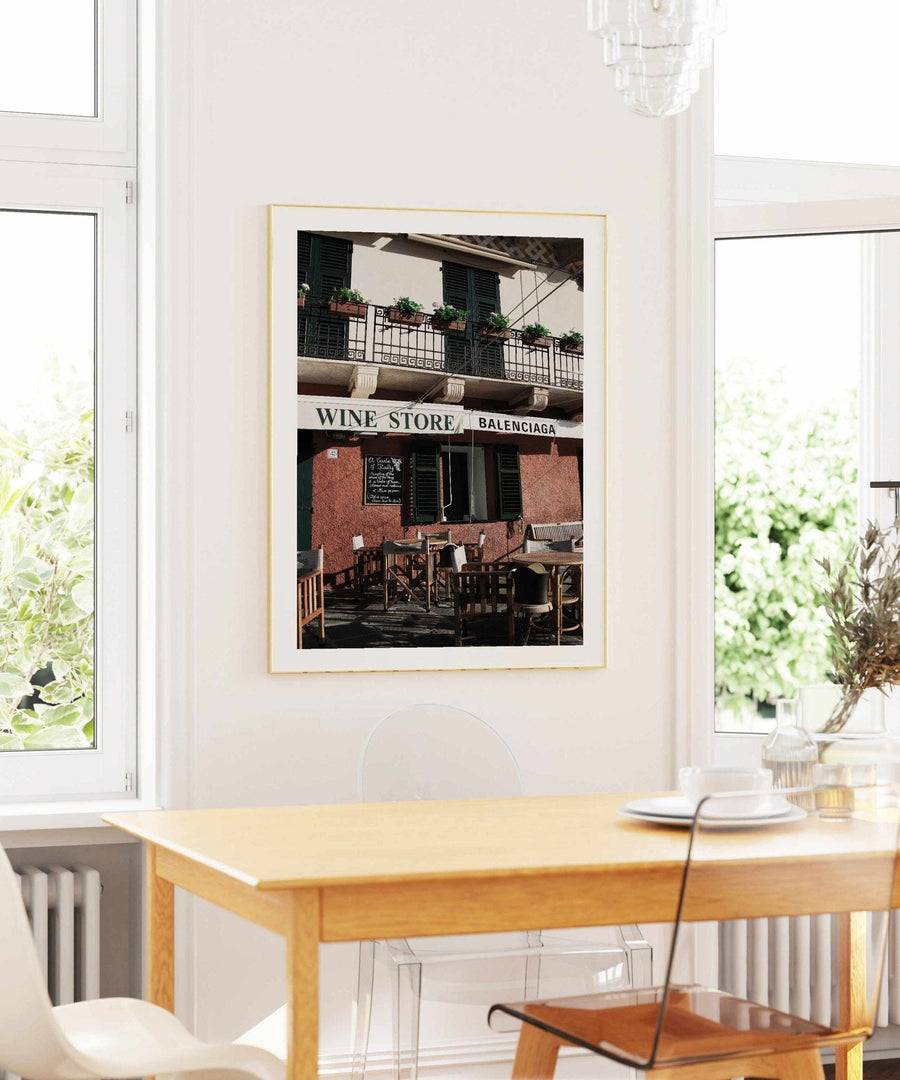
Choose matte when accuracy to the original matters most, when the work has fine detail, or when you want the frame and the image to feel quiet and considered. Behind the clear acrylic face of a framed print it reads as a clean, editorial finish.
240gsm Textured Cotton Rag Paper
Cotton rag is a high-quality fine art paper with a premium archival finish. Its textured surface catches light softly. Colour sits slightly warmer and softer than on matte, and very fine detail softens a touch because the texture breaks the surface.
It suits watercolour and gouache reproductions, charcoal and pencil drawings, loose painterly work and portraits where a softer presence is welcome. Photographers sometimes choose it for black and white or muted film-style images that benefit from texture. It's a less natural choice for razor-sharp architectural photography or tiny typographic detail.
The 100 × 130 cm limit, explained honestly
Textured Cotton Rag is available up to 100 × 130 cm and not at 120 × 150 cm. That isn't a pricing decision. The cotton stock arrives on a 1118 mm (44 inch) wide roll, and a seamless 120 cm wide sheet physically can't be cut from it. Rather than quietly substitute a different paper, the product pages simply don't offer that combination, and the artist FAQs say so. If you need a very large textured print, ask about alternatives through the quote form on the product page.
Cotton rag costs more than matte. A2 unframed is $100.95 and A2 framed in Oak veneer, White or Black is $149.95; at 100 × 130 cm, framed cotton rag is $384.95.
260gsm Metallic Pearl Paper
Metallic Pearl has a subtle sheen that brightens highlights and gives colour a lift, a little like the surface of a pearl rather than a mirror. It's the heaviest of the three and the most distinctive. Under good light the image seems to carry its own illumination.
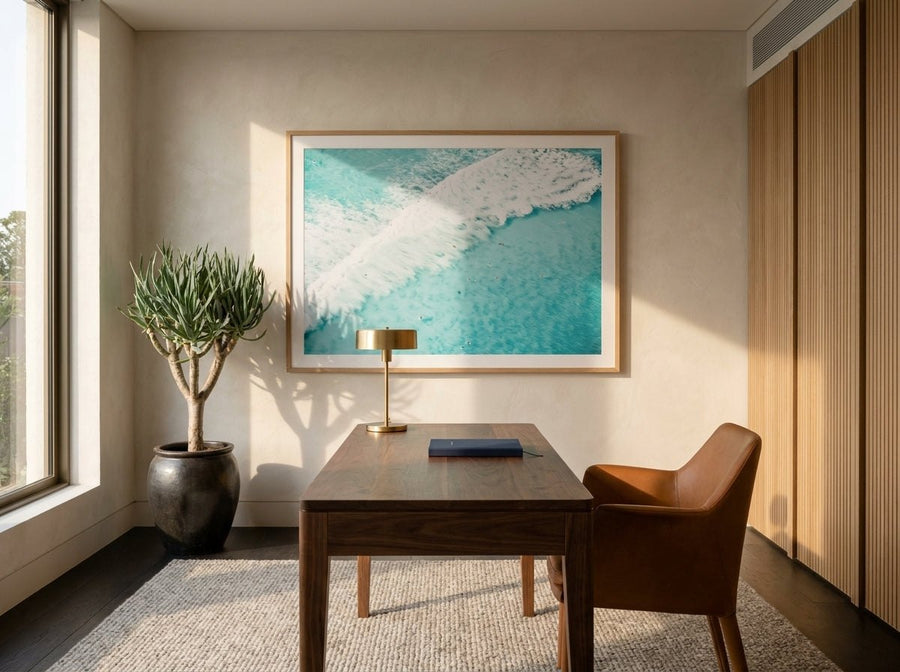
It was added with aerial and coastal photography in mind. Turquoise shallows, white sand, wet rock and sunlit water gain depth and sparkle on this surface in a way matte paper can't give them. It also suits night photography, metallic or jewel-toned digital work and anything where luminosity is part of the point. It's less suited to soft watercolours or work that depends on a flat, quiet surface, because the sheen will read as glossy against delicate tones.
Metallic Pearl is available in all six listed framed sizes and is offered framed only, behind the clear acrylic face. A2 framed in Oak veneer, White or Black is $169.95; 120 × 150 cm framed is $629.95. Australian Raw Oak frames carry a premium on every stock.
How each paper changes your file preparation
Matte and cotton rag both absorb ink into the surface, so blacks are rich but not glossy. Pearl sits ink nearer the surface and reflects more light, which makes highlights brighter and midtones slightly more saturated. If you plan to offer the same artwork on more than one paper, judge each on a real print rather than expecting identical results. The file preparation guide covers resolution and colour space, which don't change between papers, and the colour management guide explains why screens and papers disagree.
Cotton rag's texture is kinder to files that are slightly under resolution, because the surface already softens detail. Matte is the least forgiving; what's in the file is what you'll see.
Border or edge to edge
On all paper products you can choose an even 5cm unprinted white border or print edge to edge. The border is unprinted paper, not a mat. On textured cotton rag the border shows off the paper itself and suits the handmade feel. On matte it gives a clean, gallery-like margin. On metallic pearl an edge to edge print lets the sheen run to the frame, while a border frames the glow with a quieter white. The border or edge to edge guide takes the decision further.
Which paper for which work
- Watercolour, gouache, pastel: cotton rag first, matte second.
- Pencil, charcoal, ink drawing: cotton rag for texture, matte for crisp line.
- Digital illustration, flat colour: matte.
- Oil and acrylic reproductions: matte for accuracy, cotton rag for a softer, more painterly surface. Consider framed canvas as well; the paper versus canvas guide compares them.
- Aerial and coastal photography: metallic pearl, with matte as a classic alternative.
- Portrait and wedding photography: matte or cotton rag. The wedding photographer's guide explains the client-facing side.
- Black and white photography: matte for depth, cotton rag for a film-like texture.
- Architectural and product photography: matte.
Offering more than one paper
Giving collectors a paper choice can lift your average order value, but only if the choice is explained. "Printed on high-quality 240gsm Textured Cotton Rag with a premium archival finish" sells. "Paper: cotton rag" does not. Use the stock names, describe the feel, and say which you recommend for the artwork. If you'd rather keep things simple, offer matte alone and mention that other stocks are available on request.
Whatever you list, test it. Order one print on each paper you plan to offer, in the size you expect to sell most, and look at them together in daylight. The pre-launch test order checklist is built for exactly this.
Price summary
In Oak veneer, White or Black frames, Australian dollars including GST, before delivery:
- 230gsm Premium Matte: A2 $119.95 to 120 × 150 cm $349.95
- 240gsm Textured Cotton Rag: A2 $149.95 to 100 × 130 cm $384.95
- 260gsm Metallic Pearl: A2 $169.95 to 120 × 150 cm $629.95
Unframed on 230gsm matte: A2 $64.95 to 120 × 150 cm $259.95. Unframed on cotton rag: A2 $100.95 to 100 × 130 cm $302.95. The pricing guide shows how those production charges become your selling price.
How the paper meets the frame
Paper and frame are chosen together, and some pairings simply work. Matte with Oak veneer is the classic gallery pairing: quiet surface, warm consistent edge, suits almost everything. Matte with Black sharpens a photograph or a graphic illustration. Textured cotton rag with White makes watercolour and drawing feel light and handmade. Textured cotton rag with Australian Raw Oak doubles down on natural materials and suits earthy, botanical or folk work; describe the timber variation honestly, as the frame finish guide explains. Metallic pearl with Black turns a night or water image into something that seems to glow in the frame; metallic pearl with White keeps the glow airy for coastal work.
Behind the clear acrylic face every paper reads slightly glossier than it does bare, because the acrylic adds its own gentle reflection. Matte stays the most subdued, cotton rag keeps its texture visible, and pearl's sheen is amplified a little. If a collector will see the print mostly under strong window light, matte is the most forgiving choice.
The unframed path and local framing
Many collectors prefer to frame locally, especially overseas buyers or anyone with a specific interior in mind. For them the unframed fine art print on matte or cotton rag paper, with an even 5cm white border, is the right product: the border gives a framer room to work and the print travels at a fraction of the freight of a framed piece. Tell these collectors the stock and weight so their framer knows what they're handling, and suggest UV-protective glazing if the print will hang in a bright room. The border or edge to edge guide explains why the border helps here.
Paper and longevity
All three stocks are printed with archival pigment inks, and all three are fine art papers chosen for that purpose. Weight doesn't change longevity; surface and display conditions do. Matte and cotton rag absorb ink into the surface and are robust under normal indoor display. Pearl sits ink nearer the surface behind a protective acrylic face. In every case, keeping the print out of direct sun and away from humidity does more for its life than any difference between the three. The giclée and archival printing guide explains what you can honestly say to collectors about how long a print lasts. The fine art printing for artists page is the short version of this guide for anyone deciding quickly.
Frequently asked questions
What is the standard paper at Print Punch?
230gsm Premium Matte Fine Art Paper. It's smooth, glare-free and available in all six listed sizes, framed and unframed.
Why isn't cotton rag available at 120 × 150 cm?
The cotton stock comes on a 1118 mm wide roll, so a seamless 120 cm wide sheet can't be cut from it. It's available up to 100 × 130 cm.
Is Metallic Pearl available unframed?
No. Metallic Pearl is offered as a framed paper print behind clear acrylic, in all six listed sizes.
Which paper is best for photographs?
Matte for most photography, including black and white and portraits. Metallic Pearl for aerial, coastal and luminous images. Cotton rag for a premium archival finish with a textured surface.
Does heavier paper mean better quality?
Not on its own. Weight adds stiffness and presence. Surface (matte, textured or pearl) is what changes how colour, detail and light behave.
Can I request a paper that isn't listed?
Yes. Other stocks are quoted separately. Use the custom quote form on the product page or the contact page with your artwork, size and the paper you have in mind.
Choose your surface
Open the framed paper prints page, upload your artwork, and switch between the three stocks in the configurator to see the price for each. For unframed work, the unframed fine art prints page offers matte and cotton rag. If you'd like a recommendation for a specific artwork, send us the file and a line about it.