ARTIST JOURNAL
Oak veneer or Australian Raw Oak: choosing a frame finish for your edition

Two frames can both be called oak and make two very different promises. One promises that every edition you send will look like the last. The other promises that every frame will be a little different, because real timber is. Neither promise is better; they suit different artists, different artworks and different collectors. This guide explains how Print Punch's Oak veneer and Australian Raw Oak finishes are made and how they behave, where White and Black fit, what each costs, and how to describe the choice so collectors get exactly what they expect.
The four finishes
Print Punch frames come in Oak veneer, Australian Raw Oak, smooth White and smooth Black. All four are available on framed paper prints, framed canvas prints and blank canvas with a floating frame. The profile is a slim, flat face: around 2 cm wide on framed paper, with a depth of about 3 cm up to 70 × 100 cm and 4 cm at 100 × 130 cm. The frames and materials page photographs each finish, and the specifications section records the dimensions.
Oak veneer: visible grain, consistent tone
Oak veneer is a thin layer of real oak bonded to the moulding. You see genuine grain, but because veneer is selected and matched, colour and tone stay consistent across the four sides of a frame and from one frame to the next. It's warm without being rustic, and it sits quietly beside almost any palette.
Choose Oak veneer when:
- You're selling an edition and want every piece to match.
- A collector is buying several works to hang together.
- The artwork is detailed or delicate and the frame should recede.
- You're a photographer or illustrator building a consistent product range.
It's the default timber choice for good reason, and it's priced the same as White and Black.
Australian Raw Oak: natural variation, celebrated
Australian Raw Oak is a natural timber finish. The four moulding lengths that make up a frame can vary noticeably in colour, tone and grain, and they are not expected to match exactly. One side may run warmer, another may show a stronger grain pattern. That is the character of Australian oak, not a flaw, and it's exactly what some artists and collectors want: a frame that reads as a piece of timber rather than a manufactured edge.
Choose Australian Raw Oak when:
- The artwork has an earthy, natural or textured feel that suits variation.
- You're selling one-off framed pieces or originals rather than a matched edition.
- Your collectors value natural materials and will appreciate individuality.
- You want a premium option in your range with a clear reason behind the price.
Because the finish varies by nature, a frame profile photograph is a shape reference rather than a colour guarantee. The product pages and the artist FAQs say so, and your listing should too.
Smooth White and smooth Black
Both are smooth gesso finishes with no visible timber grain. White lightens the edge and lets pale, airy work breathe; it's a favourite for watercolour, coastal photography and nursery or soft interior pieces. Black sharpens the edge and adds definition; it suits high-contrast work, black and white photography, dark palettes and anything that wants to read as crisp and contemporary. Both are priced with Oak veneer and give perfectly consistent results across an edition.
Price differences
Oak veneer, White and Black share the same price at every size. Australian Raw Oak carries a premium because the timber and the finishing are different. In Australian dollars including GST, before delivery:
- Framed paper print A2 on matte stock: $119.95 in Oak veneer, White or Black; $159.95 in Australian Raw Oak.
- Framed canvas A2: $169.95 in Oak veneer, White or Black; $229.95 in Australian Raw Oak.
- Blank canvas A2 or 50 × 50 cm: $109.95 in Oak veneer, White or Black; $149.95 in Australian Raw Oak.
At the largest sizes the gap grows in dollars: a 120 × 180 cm framed canvas is $789.95 in the standard finishes and $1,069.95 in Australian Raw Oak. The pricing guide shows how to carry that premium through to a coherent retail ladder, and the margin calculator on each product page lets you test it.
How each finish meets different artwork
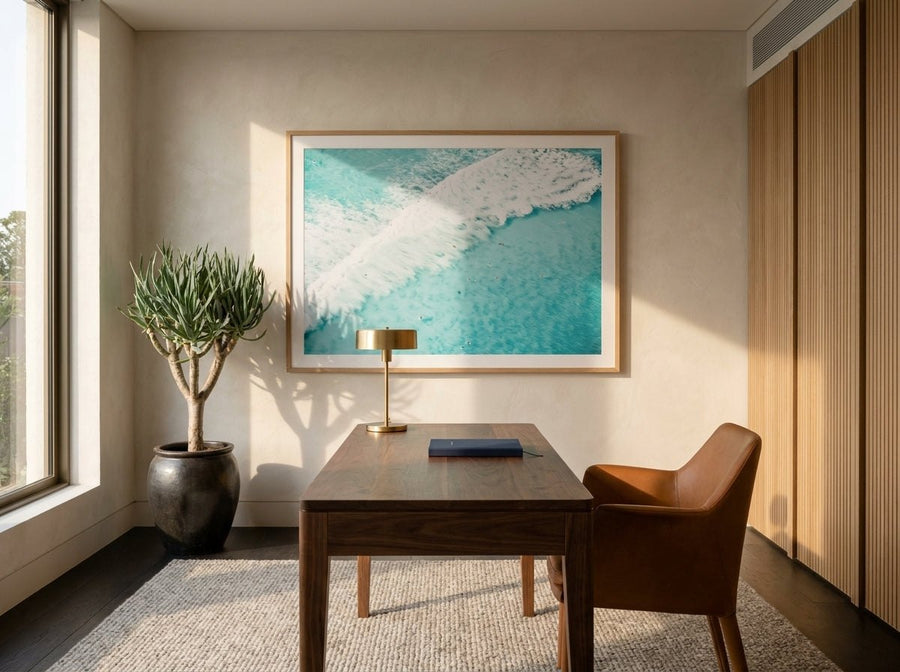
Coastal and aerial photography. Oak veneer or White. The frame should recede behind water and sand. Australian Raw Oak can work for warmer, sunlit images where the timber tone echoes the scene.
Painterly abstracts and textured work. Australian Raw Oak is a natural partner; the variation in the timber speaks the same language as the brushwork. Black for dramatic, high-contrast abstracts.
Botanical and watercolour. Oak veneer or White for a soft, consistent edge. Raw Oak if the work is loose and earthy.
Black and white photography and ink drawing. Black for definition, Oak veneer for warmth, White for a gallery-clean look.
Digital illustration with flat colour. White or Black depending on the palette; Oak veneer for a warmer, more domestic feel.
Portraits. Oak veneer most often. Raw Oak for a rustic or heritage mood.
The paper versus canvas guide covers how the surface and the frame work together, and the fine art paper guide is worth reading alongside, because paper surface and frame finish are chosen together.
Describing the choice to collectors
The words you use matter more here than anywhere else in your listing, because Australian Raw Oak's variation is a feature only if the collector chose it knowingly. A fair description reads something like: "Australian Raw Oak is a natural timber finish. The four lengths of the frame can differ in colour, tone and grain and are not expected to match exactly. Choose Oak veneer if you prefer a more consistent finish." Put that sentence next to the option, not buried in a policy. It's the sentence Print Punch uses on its own product pages for the same reason.
For Oak veneer, White and Black, a simple line does the job: "Oak veneer with visible grain and consistent colour", "Smooth white gesso with no visible grain", "Smooth black gesso with no visible grain".
Consistency across a series
If you sell a series meant to hang together, use Oak veneer, White or Black for all of them. Even if a collector buys them months apart, the frames will match. Australian Raw Oak will not, by design, so offer it on individual pieces rather than matched sets unless you've explained the variation and the collector wants it.
The same logic applies to blank canvases for painters. A body of work in Oak veneer presents as a unified set. A body of work in Raw Oak presents as a set of individuals. The blank canvas guide goes into size and finish choices for painters.
Care and handling
All four finishes prefer the same treatment: dust with a dry, soft cloth, keep cleaning sprays and solvents away from the frame face, and avoid prolonged direct sunlight, which affects timber tone over years as well as the print. Framed paper prints sit behind a clear acrylic face that protects the print; the frame itself is exposed and should be handled by the edges. Pass a short care note to collectors with each piece.
Seeing the finishes before you choose
Photographs help, but timber is best judged in the hand. The lowest-cost way to see a finish is a small framed paper print or an A2 blank canvas in that finish, ordered to your own address. If you plan to offer Australian Raw Oak, order one so you understand the degree of variation you're describing to collectors. The test order checklist covers what to inspect, and the how it works page explains the order path.
Where the frame meets the artwork
The frame's job changes with the format. On a framed paper print the frame holds the acrylic face and the paper, and the frame edge sits directly against either the image (edge to edge) or the white border. With a border, the frame finish has white space to play against, so Black looks graphic and Oak veneer looks classic. Edge to edge, the finish meets the colour of your image directly, so a warm image in Oak veneer feels continuous and a cool image in Black feels contained. The border or edge to edge guide covers that decision.
On a framed canvas the floating frame never touches the artwork; a thin charcoal shadowline separates them. That gap lets the frame finish sit as its own element, which is why Australian Raw Oak works so well on canvas: the timber variation reads as a deliberate border rather than as an edge trying to match the image. On a blank canvas the same applies, with the added consideration that you'll be painting up to that gap; the blank canvas guide covers masking the frame while you work.
Photographing each finish for your listing
Oak veneer and Australian Raw Oak photograph best in soft, slightly directional daylight that shows the grain without glare; shoot a corner detail at an angle. White needs a background that isn't white, or the frame disappears; a pale grey wall or a timber floor behind it helps. Black needs enough light on the frame face to show it's smooth rather than a void; a touch of reflection on the gesso reads as quality. For Raw Oak, photograph a whole frame so the variation between the four lengths is visible in your listing image, which is the honest way to show what collectors will receive.
Finishes and price across the range
Oak veneer, White and Black are priced identically at every size on every product. Australian Raw Oak carries a premium across framed paper, framed canvas and blank canvas. Because the premium is a fixed uplift per size, offering Raw Oak as a selectable upgrade at your own price is simple: apply your usual margin to the Raw Oak production charge and let collectors choose. The pricing guide covers the maths, and a Raw Oak option often lifts average order value among collectors who value natural materials. Whichever finish you lead with, the print formats page shows every product and the artist FAQs answer the quick questions.
Choosing when you're unsure
If you can't decide, lead with Oak veneer and offer Australian Raw Oak as a named upgrade. Oak veneer suits the widest range of artwork and interiors and gives you consistent frames across an edition, which protects you when a collector buys a second piece a year later. Raw Oak then becomes a choice collectors make deliberately, with the variation explained, at a premium that reflects the timber. That structure keeps your range simple, your margins coherent and your descriptions honest, and it lets the artwork rather than the frame make the first impression.
Frequently asked questions
What is the difference between Oak veneer and Australian Raw Oak?
Oak veneer shows real grain with consistent colour and tone across a frame and between frames. Australian Raw Oak is a natural timber finish whose four lengths can vary noticeably in colour, tone and grain and are not expected to match exactly.
Is Australian Raw Oak a lower quality frame?
No. It's a different finish with a premium price. The variation is the natural character of the timber, not a defect.
Which finish is best for a matched series?
Oak veneer, smooth White or smooth Black. Australian Raw Oak varies by nature and suits individual pieces.
Why does Australian Raw Oak cost more?
The timber and finishing differ from the veneer and gesso options, so it carries a premium at every size on framed paper, framed canvas and blank canvas.
Do the frames show grain in White and Black?
No. White and Black are smooth gesso finishes without visible timber grain.
Can I see a frame before I sell it?
Yes. Order a small framed print or blank canvas in the finish you plan to offer and inspect it in daylight. That's the test order approach Print Punch recommends before any launch.
Choose with confidence
Compare the finishes on the frames and materials page, then open the product you plan to sell and switch between finishes in the configurator to see each price. If you'd like a recommendation for a particular artwork, send us the image and a line about the collector you have in mind.