ARTIST JOURNAL
Framed paper prints or canvas: choosing a format for your art

Most artists arrive at this decision backwards. They ask "which sells better, paper or canvas?" when the more useful question is "which one lets this particular artwork look the way I meant it to?" Paper and canvas don't just feel different in the hand. They change how colour sits, how detail reads from across a room, what the frame does, and what the collector pays. This guide takes each difference in turn so you can decide with your eyes open, and it finishes with suggestions by art style.
The two constructions, plainly
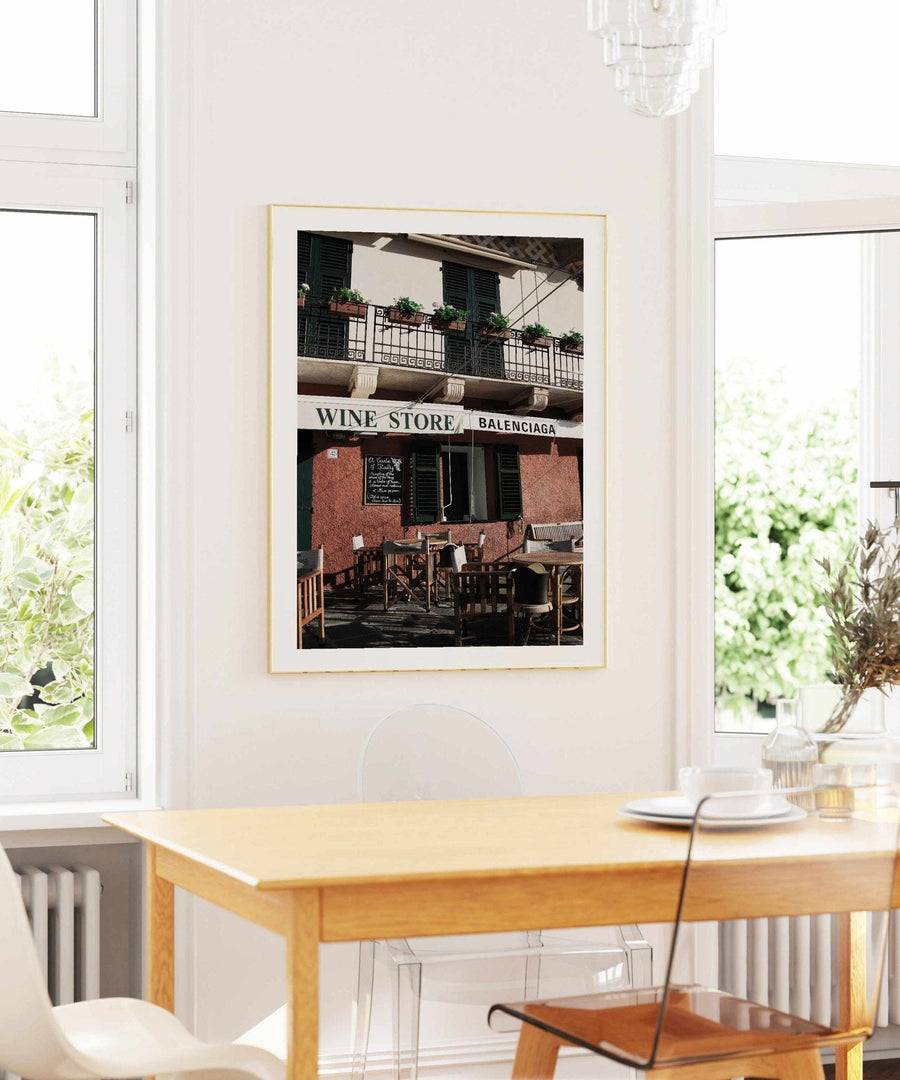
A framed paper print is your artwork printed on fine art paper, placed behind a clear acrylic face and set in a frame. Print Punch offers three papers: 230gsm Premium Matte Fine Art Paper, 240gsm Textured Cotton Rag Paper and 260gsm Metallic Pearl Paper. The frame face is around 2 cm wide, with a depth of roughly 3 cm up to 70 × 100 cm and 4 cm at 100 × 130 cm. You can choose an even 5cm unprinted white border or print edge to edge. Full details sit on the framed paper prints product page.
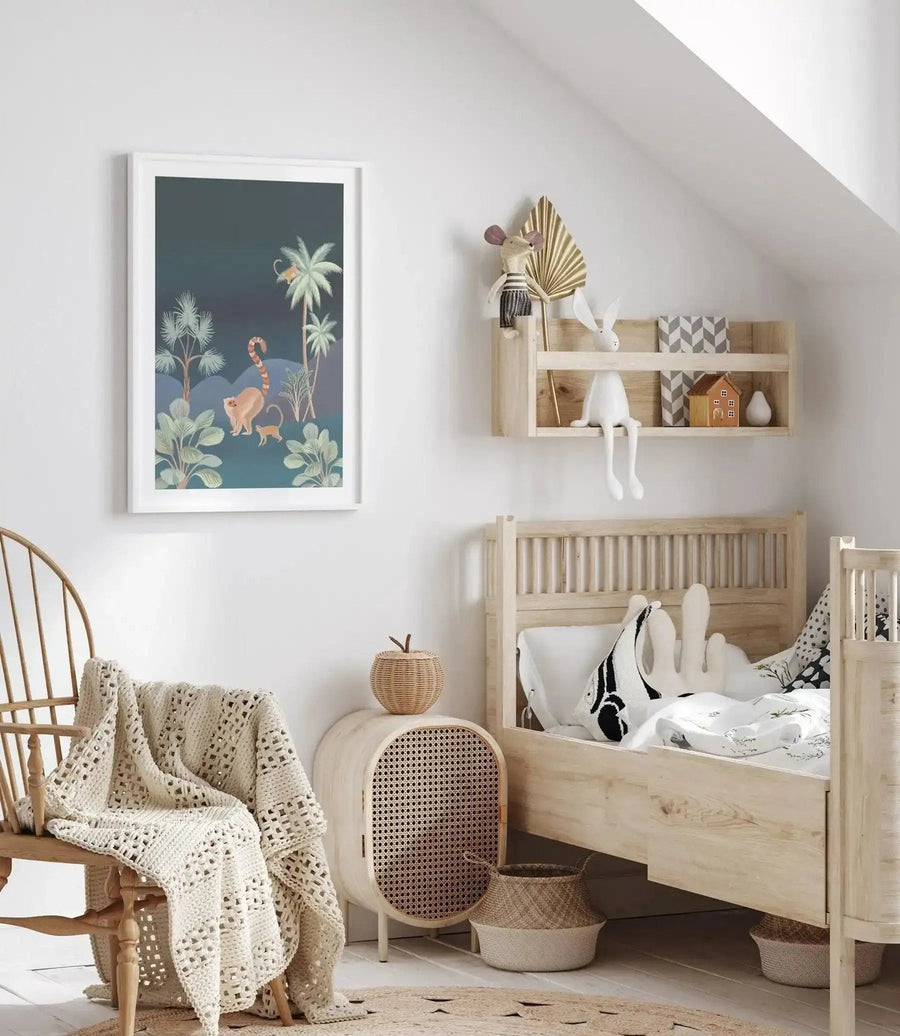
A framed canvas print is your artwork professionally printed on canvas, stretched, then set in a floating frame. A thin charcoal shadowline separates the canvas from the frame, which gives the piece a sense of depth. There is no acrylic and no border; the artwork runs to the canvas edge. See the framed canvas prints product page.
Both come in Oak veneer, Australian Raw Oak, smooth White or smooth Black. The frames and materials page shows each finish in full.
How colour behaves
Paper, especially the matte stock, gives you the most faithful reproduction of fine tonal shifts. Soft gradients in a watercolour wash, the pale greys in a black and white photograph, the subtle warmth in skin tones: matte fine art paper holds all of it without adding its own character. The acrylic face adds a slight sheen when light hits it directly, which some artists love for the finished, gallery feel and others avoid for rooms with strong window light.
Canvas has a weave. Ink sits into that texture, which softens very fine detail slightly and gives colour a richer, more painterly presence. Saturated colours look confident on canvas. Deep blues and greens sit well. Pale, delicate work can look a little muted by comparison, because the texture breaks up large smooth areas.
If colour accuracy to the original is your highest priority, paper is the safer choice. If presence and texture matter more than exact match, canvas earns its place. Either way, read why print colours differ from your screen before you judge a first print under the wrong light.
How detail reads
Fine linework, tiny lettering, architectural edges and photographic sharpness all favour paper. The surface is smooth, so a hairline stays a hairline. This is why illustrators and photographers usually begin with framed paper, and the illustrator's guide to prints explains that preference.
Canvas is kinder to work that was already soft. Loose brushwork, abstract fields of colour, impasto captured in a photograph of the original: the weave adds to that character rather than fighting it. If your original was painted on canvas, printing on canvas can bring back some of the surface feeling the photograph lost.
How each format fills a size
Paper prints can carry a border. An even 5cm white area around the image gives the artwork breathing room inside the frame and, usefully, lets you fit an artwork whose proportions don't quite match the paper size without cropping. Canvas has no border option, so your artwork must either fill the canvas face or be cropped to fit. The product page preview offers "Fill and crop" and "Keep full artwork" so you can see exactly what happens at each size. The guide to standard sizes and aspect ratios explains which proportions suit which sizes, and the border or edge to edge guide covers the border decision in more depth.
Canvas also offers square sizes that paper does not: 70 × 70, 90 × 90, 100 × 100 and 120 × 120 cm. If your work is square, canvas may be the only framed format that fits without a border or crop.
What the frame does
On a paper print, the frame and acrylic contain the artwork. It feels finished and protected, and the border (if you choose one) becomes part of the composition. On canvas, the floating frame surrounds the artwork with a deliberate gap, so the canvas appears to hover inside it. The effect is quieter and more contemporary, and it suits large statement pieces.
Finish choice matters on both. Oak veneer gives visible grain with consistent colour. Australian Raw Oak is a natural timber with real variation between lengths, which many artists want for its character. White lightens the edge; Black sharpens it. The guide to Oak veneer and Australian Raw Oak helps you decide between the two timber options.
A practical note on consistency: if you sell a series and want every piece to match, Oak veneer, White or Black will give you that. If you want each piece to feel slightly individual, Australian Raw Oak does it naturally. Tell collectors which they're getting, in plain words, so the variation is a feature they chose rather than a surprise they didn't.
What the collector pays
Canvas costs more to make. An A2 framed paper print in Oak veneer, White or Black starts at $119.95; the same size framed canvas starts at $169.95. At 100 × 130 cm, framed paper on matte stock is $259.95 and framed canvas is $599.95. All prices are Australian dollars including GST, before delivery. Australian Raw Oak carries a premium on both formats.
That difference flows through to your selling price and your margin. The pricing guide for independent artists shows how to build a price from the production charge, and each product page has a margin calculator so you can test numbers before you publish them.
Weight, packing and delivery
A framed paper print is glazed with acrylic rather than glass, which keeps weight down and removes the breakage risk of glass in transit. A framed canvas is lighter still for its size because there is no glazing at all, though large canvases are bulky. Delivery is calculated at checkout from size, weight and destination for both formats. The post on turnaround, packing and shipping covers how pieces are protected for the journey.
If you plan to sell internationally, large framed pieces attract higher freight than unframed prints, and local duties and taxes are the recipient's responsibility. Factor that in when deciding which formats to offer overseas collectors.
Suggestions by art style
- Watercolour and gouache. Framed paper on matte stock, usually with a white border. Canvas texture fights the delicacy.
- Oil and acrylic paintings. Framed canvas restores surface character. Paper works too for a crisper, more editorial feel.
- Ink illustration and linework. Framed paper, edge to edge or bordered. Detail stays sharp.
- Digital illustration with flat colour. Either. Paper for clean edges, canvas for a softer, more handmade feel.
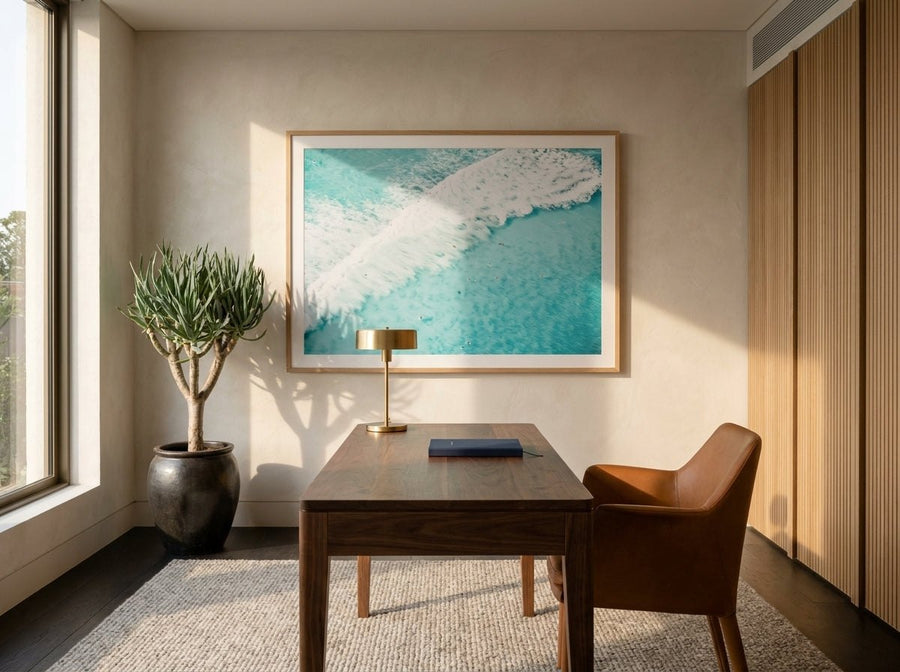
- Landscape and aerial photography. Framed paper. Metallic Pearl paper suits coastal and aerial work with a subtle shimmer. Read the fine art paper guide.
- Portrait and wedding photography. Framed paper on matte or textured cotton rag, bordered. The wedding photographer's guide goes further.
- Abstract colour fields. Framed canvas, especially in square sizes.
Offering both
Plenty of artists offer the same artwork as a framed paper print and as a framed canvas, at different price points. That works well as long as you preview both and describe each honestly. A collector who chooses canvas should know the texture softens detail; a collector who chooses paper should know the acrylic face catches light. Clear descriptions reduce returns, and the refund policy explains how made-to-order pieces are handled.
A worked example: one coastal painting, two formats
Take a loosely painted coastal scene, roughly 4:5 in proportion, with a pale sky and a saturated band of sea. As a framed paper print at 70 × 100 cm on matte stock with a 5cm border, the sky stays soft and the border gives the horizon some quiet around it. The acrylic face adds a slight sheen that reads as finished and intentional. Production charge: $179.95 in Oak veneer, White or Black.
As a framed canvas at 70 × 100 cm, the same painting fills the face edge to edge. The sea gains weight from the weave, the sky picks up a little texture, and the floating frame lets the piece sit forward from the wall. Production charge: $399.95 in the same finishes. Same artwork, two different objects, two different prices. Neither is wrong. The canvas version suits a living room above a sofa where it needs to carry the wall; the paper version suits a hallway or bedroom where a lighter touch is welcome. Describing them that way in your listing helps a collector choose, and that is far better than hoping they guess.
What collectors tend to ask
Collectors rarely ask about gsm or stretcher bars. They ask three things: will it match what I saw on screen, will it arrive safely, and how do I hang it. Answer all three in your listing. For colour, explain that paper prints use archival pigment inks and canvas prints are professionally printed and that screens vary. For transit, mention the acrylic face (no glass to break) or the frame's protective packing. For hanging, describe the frame depth and the fixing you recommend for the size. These short reassurances do more for conversion than a paragraph about ink chemistry.
A second pattern worth knowing: collectors buying canvas are usually buying for a specific wall and want scale. Collectors buying paper are more often buying the image and will frame or place it flexibly. That is one reason the larger canvas sizes exist in the Print Punch range while paper stops at 120 × 150 cm.
Before you decide
Whichever you choose, place one paid test order first. Seeing the real piece settles the question faster than any guide, including this one. The test order checklist tells you what to inspect when it arrives.
Reading the artwork before you decide
A quick way to settle the paper or canvas question is to look at the artwork's three loudest qualities and let them vote. First, edge quality: are the edges crisp and intentional, or soft and loose? Crisp votes paper. Second, surface: does the original have texture that matters to the work, or is it flat? Texture votes canvas. Third, scale: will it hang as a large statement piece or as part of a group? Large statement votes canvas; grouped pieces vote paper, because frames with acrylic faces read cleanly side by side. Two votes out of three usually gives you the answer, and the third quality tells you what to mention in the listing so a collector understands the trade-off.
It also helps to think about who buys your work. Interior designers and stylists often prefer canvas for large walls because there's no reflection to manage in a photograph of the room. Collectors who already own framed prints tend to buy more framed prints, because they match. Gift buyers lean to framed paper at small and mid sizes, which arrive finished and hang anywhere. None of these are rules, but they're patterns worth weighing when you decide which format to lead with.
A note on photographing each format for your listing
Whichever format you choose, your listing photograph should be of the real object from your test order, not a mock-up. Photograph framed paper slightly off axis so the acrylic doesn't mirror your camera, in soft daylight, and include one straight-on shot for the image itself. Photograph canvas straight on and then at an angle that shows the floating frame's depth and the shadowline, because that depth is the reason collectors pay more for it. If you offer both, show them side by side once; buyers understand the difference instantly when they can see it. For a shorter overview of each format, see the framed prints for artists page and the framed canvas page.
Frequently asked questions
Is canvas or paper better for selling art prints?
Neither is better in general. Paper reproduces fine detail and subtle colour most faithfully and costs less. Canvas adds texture and presence and suits painterly or bold work. Choose by what the artwork needs, then by price point.
Does a framed paper print use glass?
No. Print Punch framed paper prints use a clear acrylic face, which is lighter than glass and far less likely to break in transit.
Can I get a white border on canvas?
No. Canvas prints run to the canvas edge inside a floating frame. The even 5cm white border is available on paper prints only.
Which sizes are available on each format?
Framed paper comes in six sizes from A2 to 120 × 150 cm. Framed canvas comes in eleven sizes including squares, from A2 to 120 × 180 cm. Custom sizes for either can be requested through the quote form on the product page.
What is the price difference between paper and canvas?
At A2, framed paper on matte stock starts at $119.95 and framed canvas at $169.95, in Australian dollars including GST before delivery. The gap widens at larger sizes.
Can I offer the same artwork in both formats?
Yes. Many artists do. Preview both on the product pages, describe each honestly, and consider testing the one you expect to sell most before launch.
Next steps
Open the framed paper prints and framed canvas prints pages side by side, upload the same file to each, and compare the previews. The artist FAQs answer the smaller questions, and if your artwork needs a size that isn't listed, the quote form on either product page will reach our team.